International massage certificate: what to check
“International certificate”, “internationally recognised certificate”, “European certificate” — these phrases crop up often in massage-course advertising. But what do they actually mean? And does such a certificate give you the right to work as a massage therapist in Cyprus or another country?
If you are choosing professional massage training, it is important to get to the bottom of this before you pay for a course, not after you receive an attractive-looking document.
Because the words “International Certificate” in themselves say nothing about the quality of the training, the graduate’s qualification or their right to practise professionally.
Let’s take it step by step.
Does a “European-standard certificate” exist?
The short answer is no — there is no single “European-standard” massage therapist’s certificate.
The European Union does not issue a universal massage therapist’s certificate that, on completion of any course, automatically grants the right to work in all EU countries.
What is more, even within the European Union the requirements for one and the same professional activity can differ from country to country.
So the phrases:
- “European-standard certificate”;
- “international diploma”;
- “internationally recognised certificate”
cannot be taken as independent proof of professional status.
They are above all marketing phrases — unless they are backed by an explanation of who exactly recognises the programme, what was checked and what professional opportunities the graduate gains.
What does a training certificate actually confirm?
Any training centre or legal entity can issue its own certificate of course completion.
In itself, a certificate primarily confirms:
- who provided the training;
- who completed the training;
- the name of the programme;
- the duration of the training;
- sometimes the content of the programme;
- whether a final assessment was included.
But the existence of a certificate does not automatically mean that the programme meets the requirements of any professional organisation or state.
And still less does it mean that this document gives an unconditional right to practise a particular profession anywhere in the world.
And here we come to the most important question.
Does a certificate give you the right to work as a massage therapist?
The better question to ask is not “is this an international certificate?” but:
“What requirements for professional activity exist in the country where I intend to work, and does my education meet them?”
These are fundamentally different things.
In the European Union, professions can be regulated or unregulated.
If a profession is regulated, to gain access to it the state may require a particular education, recognition of professional qualifications, registration in a professional register, a state examination or a licence.
So a document that allows you to work in one country does not necessarily grant the same rights automatically in another.
And how does this work in Cyprus?
In Cyprus it is important to distinguish between the work of a massage therapist in the wellness field and regulated medical professions.
Physiotherapist, for example, is a regulated profession. To work as a physiotherapist in the Republic of Cyprus you must hold the appropriate education, be registered in an official register and obtain a licence to practise professionally.
So a massage course and a massage therapist’s certificate do not give the right to call yourself a physiotherapist or to carry out activities reserved for physiotherapists.
At the time this article was published, massage therapist as a separate profession is not listed in the Republic of Cyprus’s official list of regulated health/welfare/beauty professions. This means that different requirements apply to a massage therapist and to a physiotherapist.
But the absence of state regulation of a profession does not mean that the quality of professional education ceases to matter.
If you intend to work with real clients, other important questions arise: professional training, safety, liability, employer requirements, professional membership and the possibility of arranging insurance.
A certificate, accreditation and a licence are not the same thing
These concepts are often confused, even though they mean entirely different things.
A training centre’s certificate. Confirms that you completed a particular training programme at a specific school.
Professional accreditation. An independent professional organisation sets its own standards and assesses whether the training centre and/or programme meet those requirements.
Professional membership. A specialist or training centre can belong to a particular association or professional organisation. But membership and accreditation are not necessarily the same thing.
State recognition or licensing. Applies to regulated professions and is determined by the legislation of a particular country.
This is precisely why an international organisation’s logo on a training centre’s website still does not answer the main question: what exactly did this organisation check?
Membership of an international organisation ≠ accreditation of a course
This is one of the most important points when choosing professional training.
A training centre can write “Member of…”, “International Member…”, “Recognised by…”, “Accredited…” and put an international organisation’s logo on its website.
But a prospective student needs to find out what lies behind that status.
In some organisations, membership means above all joining a professional community. It does not necessarily mean that independent specialists have studied the course programme, checked the number of training hours, the instructor’s qualifications, the content of the practice or the final-assessment system.
So the presence of an international logo is not in itself a sufficient criterion of quality.
What should serious professional accreditation check?
When choosing a school, ask not only “do you have international accreditation?”. Ask:
“What exactly did the organisation that accredited you check?”
Ideally, a professional assessment should touch on several levels.
1. The training centre
Who is the training provider? Are the necessary documents, professional liability cover and procedures for working with students and clients in place?
2. The specific training programme
This is especially important. Accreditation of a school as a whole does not necessarily mean automatic recognition of every course the school decides to add to its schedule.
Check:
- whether the content of this particular programme was reviewed;
- whether the number of hours meets the established requirements;
- how much theory and practice are included;
- what knowledge and skills the graduate should acquire;
- how the learning outcome is assessed.
3. The instructor’s qualification
Who will be teaching you? Does the instructor have a professional education in the specific field they teach? What is their professional experience? Are they a practising professional? Do they have a qualification or training in adult education?
An attractive school certificate does not make up for a lack of the necessary qualification in the person who actually teaches the students.
4. The student-assessment system
If a person has simply attended the sessions, is that enough to earn a certificate? Or do they have to demonstrate their knowledge and practical skills?
For professional training this is a significant difference.
7 questions worth asking a school before you pay for a course
Instead of the question “do you have an international certificate?”, ask more specific questions:
- Who issues the certificate after the course?
- Which independent professional organisation recognises the training centre?
- Has this organisation reviewed the specific programme I intend to take?
- Is the instructor’s professional qualification checked?
- How many hours of theory and practice does the programme include?
- Do I need to sit an exam or a practical assessment to earn the certificate?
- Can I obtain professional membership and arrange professional liability insurance after the training?
The answers to these questions will tell you far more about the quality of the training than the phrase “European-standard certificate”.
Why does the number of training hours matter?
Two certificates with the same course name can attest to entirely different amounts of training.
For example, one may say Swedish Massage Certificate after a few hours of a masterclass. Another may carry the same name after a programme that includes theory, anatomy and physiology, contraindications, in-person practice, independent work and a final assessment.
The name on the certificate may look the same. The specialist’s level of training is entirely different.
That is why the number of hours, the content of the programme and the assessment system often say far more about the training than the design of the certificate or the word International.
Why does professional insurance matter?
If you plan to work with clients, one of the practical questions after training is the ability to arrange professional liability insurance.
An insurance company may have its own requirements for the specialist’s qualification and for the documents confirming their training.
So even before choosing a course it is useful to find out: will you be able to use the qualification you gain to arrange professional insurance in the country where you intend to work.
This is a far more practical criterion than the phrase “international certificate”.
And what if I want to work in another country?
No professional school should promise that its certificate automatically gives the right to work anywhere in the world.
Before relocating, you must check the requirements of the specific country where you intend to carry out professional activity.
The first question: is the massage therapist profession regulated in that country?
If it is, you need to find out the competent government authority’s requirements for education and the recognition of qualifications. If the profession is not regulated, the requirements of employers, professional organisations and insurance companies may matter.
So good international professional accreditation increases the transparency and verifiability of your education, but it does not override the legislation of a particular country.
How is MAWS accreditation structured?
The Mediterranean Academy of Wellness Sciences (MAWS) holds the status of IICT Approved Training Provider — the International Institute for Complementary Therapists.
To obtain Training Provider status, the IICT procedure requires information and documentation regarding the instructors’ professional qualifications and experience, the content of the training programmes, the duration of the training, assessment methods, learning materials, insurance and the other requirements of a professional training provider.
Programmes must meet the IICT’s minimum requirements for the relevant professional field.
That is why the difference between the phrases “we belong to an international organisation” and “our training centre holds Approved Training Provider status, and our professional programmes go through a review procedure under that organisation’s requirements” is fundamental to us.
At the same time, it is important to understand the boundaries of such recognition correctly.
IICT is a professional international organisation in the field of complementary therapies, not a state education regulator of the Republic of Cyprus or the European Union. IICT professional accreditation does not turn a MAWS certificate into a state diploma and does not override the legislation of the country where a graduate intends to work.
What certificate do MAWS graduates receive?
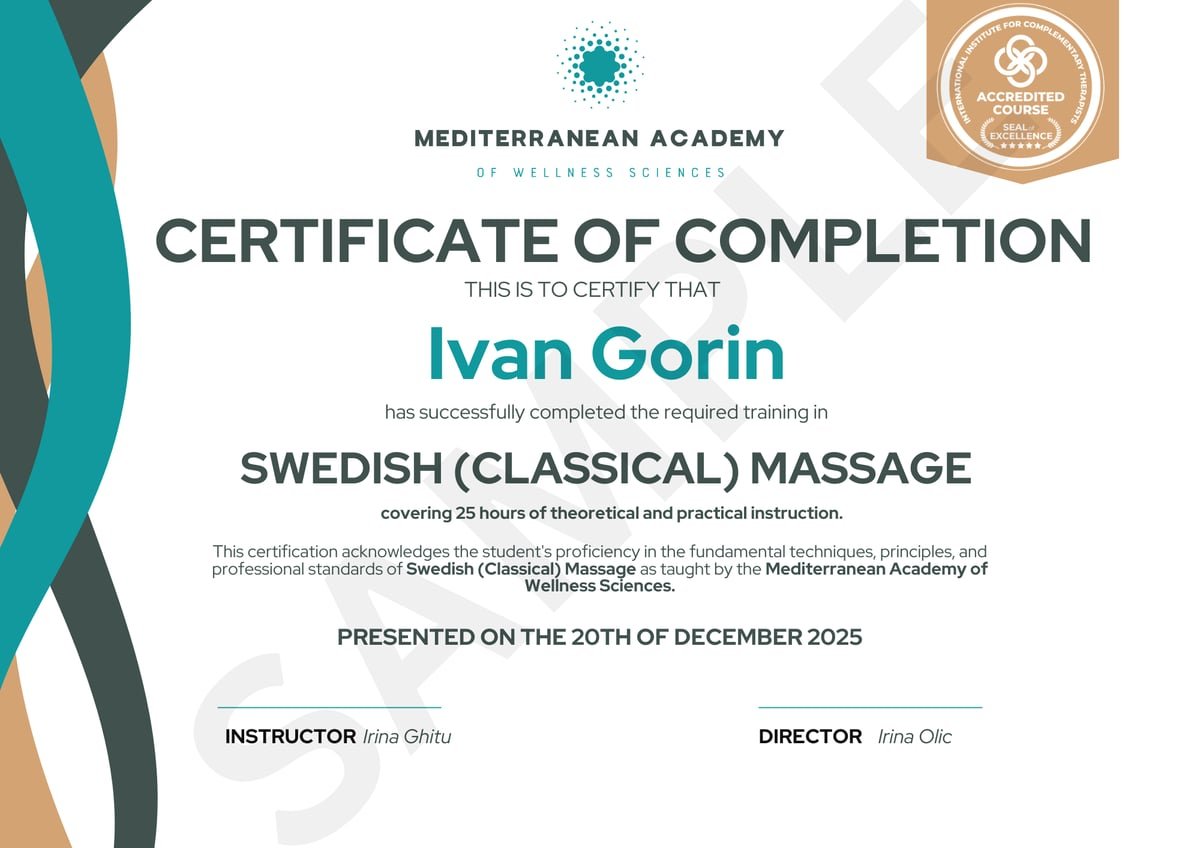
After successfully completing a professional programme and the final assessment provided for by the programme, the student receives a personalised certificate from the Mediterranean Academy of Wellness Sciences (MAWS).
The certificate states:
- the graduate’s name;
- the name of the programme;
- the volume of training;
- the training centre;
- the details provided for by the format of the professional programme.
We deliberately do not call it a “European-standard certificate”, because there is no single European-standard massage therapist’s certificate.
Something else matters more to us: that the graduate can clearly show where they studied, which programme they completed, how much training they received and which professional organisation stands behind the standards of their training.
The main thing: look not at the certificate but at what stands behind it
An attractive document can be printed in a few minutes. A professional qualification is formed differently.
Behind it should stand:
a quality programme + a sufficient number of hours + a qualified instructor + real practice + safety + assessment of knowledge and skills + professional standards.
So when choosing massage courses, don’t ask only “what certificate will I receive?”. Ask:
“What will I need to know and be able to do to earn this certificate — and who checked the quality of the programme I will be trained on?”
It is the answer to this question that shows the real value of professional education far better.
You can see how the academy’s foundation programme is structured on the Swedish massage course page. And for where to begin the path into the profession at all, see our guide How to become a massage therapist in Cyprus.